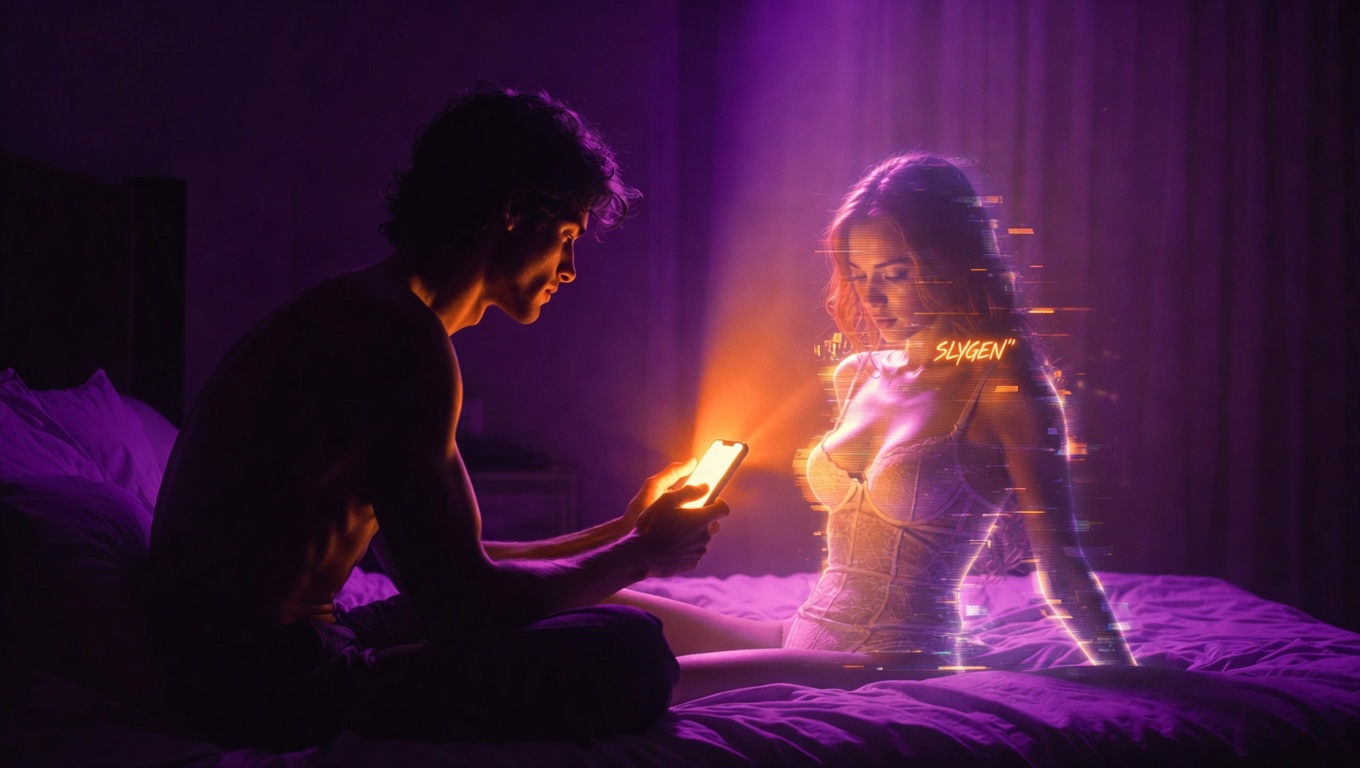
Just a short while ago, AI generation of NSFW content looked more like a curious experiment than a full-fledged tool. Neural networks often made mistakes: they broke anatomy, created strange 'plastic' faces, and got confused about light and details. Most results looked less like a finished scene and more like a demonstration that the technology 'can draw something in principle.'
But in the last couple of years, everything has changed significantly. Modern models have learned to maintain character appearance, understand composition, work with lighting, and even create videos with relatively natural movement. AI content stopped looking like a set of random frames and began approaching full-fledged visual direction.
Against this backdrop, platforms like Slygen have emerged — services where the user no longer just searches for ready-made content, but literally creates a scene for themselves. And that is where the most interesting part begins.
Because now the quality of the result depends not only on the neural network itself. Far more important has become something else — how accurately a person can explain exactly what they want to see.
What Actually Happens During AI Generation
Many still perceive generation as a 'magic button': write a prompt — get a ready scene.
In reality, the process is much more complex.
Most modern models work on the principle of gradually assembling an image from visual noise. The neural network step by step refines the shape, light, face, environment, and movement, guided by the text prompt.
For it, the prompt is a set of guides:
- how the character should look;
- what atmosphere is needed;
- what style is used;
- how the light is built;
- at what angle the scene is shown.
At the same time, the model does not 'understand' the image like a human. It matches words with a huge number of visual patterns on which it was trained. That is why the wording of the prompt here decides almost everything.
Why AI Content Became Mass-Market Exactly Now
Technically, generation existed before. But only by 2025–2026 did several factors coincide simultaneously.
Models became noticeably higher quality. Photorealism stopped looking blatantly artificial. Generation became cheaper and faster. Convenient interfaces appeared where you no longer need to figure out code, settings, and model training.
Because of this, AI for the first time stepped beyond the community of tech enthusiasts.
And what is especially important — people were hooked not only by erotica itself. The main trigger turned out to be personalization.
Instead of endlessly searching for 'that very' video, a person for the first time got the opportunity to assemble a scene to their taste: the needed appearance, mood, aesthetics, light, dynamics, and atmosphere.
Why One Prompt Works and Another Breaks the Scene
One of the most common beginner mistakes is trying to describe everything at once.
Usually, this looks like this:
- complex pose;
- several actions simultaneously;
- mixing different styles;
- overloaded background;
- dozens of clarifications in one line.
As a result, the model begins to lose priorities. Hence, typical problems appear: anatomy breaks, composition 'floats', style changes, scene logic disappears.
In practice, AI works much better with a simple and sequential structure.
The most stable scheme usually looks like this:
- Who is depicted
- What is happening
- How the environment looks
- What lighting is used
- What style or angle is needed
The more logically the prompt is built, the cleaner and more stable the result turns out.
Why Light Is Often More Important Than Appearance
Many users focus on the face, clothing, or figure of the character and hardly think about lighting. Although it is light that largely determines whether the scene will look atmospheric or cheap.
For example:
- soft diffused light makes the image calmer and more intimate;
- backlight adds volume and depth;
- neon creates the feeling of night aesthetics;
- warm light makes the scene visually 'more alive'.
Sometimes one short phrase about lighting changes the result more than a detailed description of clothing or environment.
Realism and Anime Are Two Different Generation Logics
Interestingly, photorealism and anime stylization work according to completely different rules.
Photorealism:
- reacts more strongly to errors;
- requires precise descriptions;
- handles complex poses worse;
- breaks faster when the prompt is overloaded.
Anime style:
- is much more flexible;
- holds the character easier;
- handles artistic conventions better;
- gives a more stable result even in complex scenes.
Therefore, choosing a style is not only a matter of taste. It is also a matter of result controllability.
Why Experienced Users Almost Never Create a Perfect Scene on the First Try
Good generation is almost always built through iterations.
First, a basic scene is created. Then gradually corrected:
- pose;
- facial expression;
- lighting;
- composition;
- atmosphere;
- detailing.
It is in this way that a stable and predictable result appears.
The attempt to immediately 'stuff everything' into one prompt most often ends in chaos.
What Is Changing Now in Adult Content
The most interesting thing is that AI is gradually changing the very principle of consuming visual content.
Previously, the industry was built around ready-made scenes for the widest possible audience. Now everything is shifting towards a personal experience.
The user begins to control:
- aesthetics;
- characters;
- dynamics;
- style;
- atmosphere;
- visual rhythm of the scene.
And in this sense, platforms like Slygen work no longer as ordinary content libraries, but rather as an interface between human fantasy and visual generation.
Why This Is More Important Than It Seems
AI generation has long stopped being just entertainment for technology lovers.
In fact, a new visual language is emerging, where the main role is played not by the camera or filming, but by the human ability to formulate a scene with words.
And therefore, a good result today depends less on the model itself, and more on:
- how accurately a person understands what they want to see;
- how they feel composition and atmosphere;
- which details are truly important;
- and whether they can gradually manage generation instead of waiting for 'button magic'.