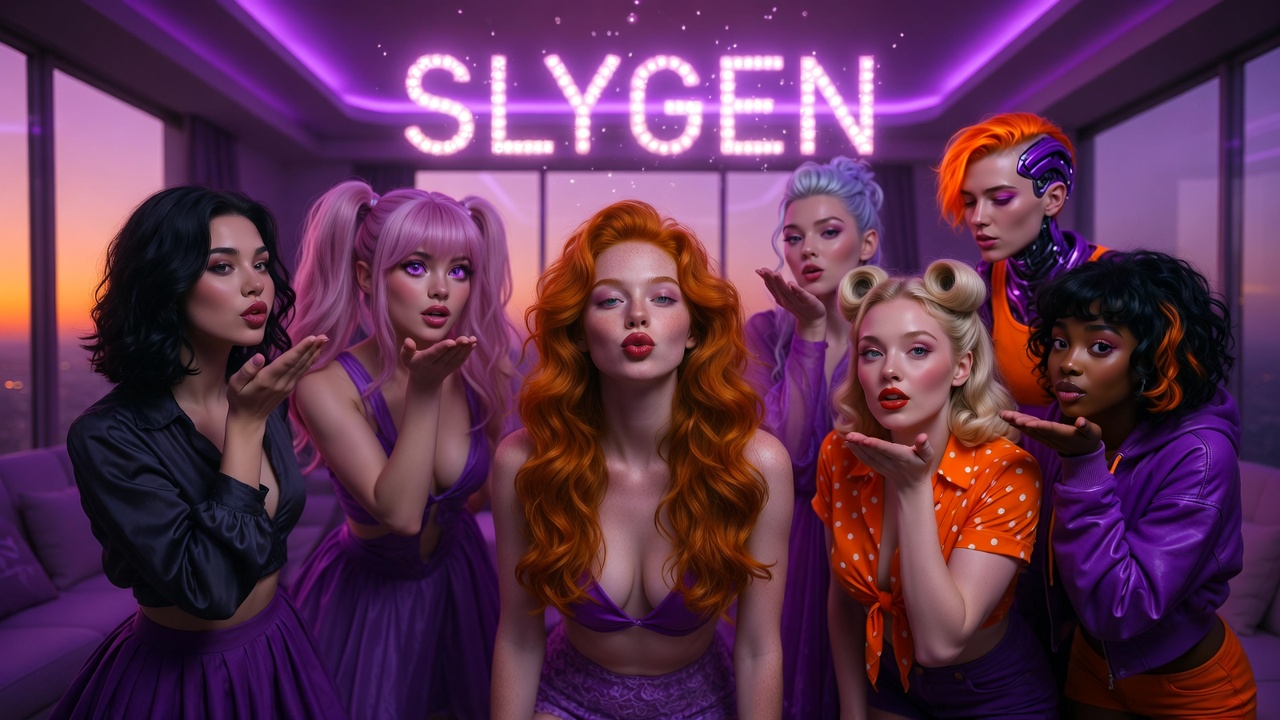
In SLYGEN, the same character can look as if they were completely different people. In one case, a photorealistic portrait with a sense of living presence. In another, a stylized anime image. In the third, a hyperbolized hentai composition. These are not just visual filters, but different ways the system interprets the image and how the viewer ultimately reads it.
Essentially, choosing a style is not about "how to draw," but "how it will be perceived": as reality, as an artistic symbol, or as an intensified fantasy. This is why queries like "AI-eroticism generation," "AI-porn character style," or "erotic AI images" yield different results even with identical character descriptions.
Realism
📷 Photorealistic portraits with natural lighting and detailed skin texture
Realism in SLYGEN works through the illusion of presence. The task here is not to "make it beautiful," but to ensure the image is perceived as a frame from the real world. Therefore, this style is most often used in queries like "AI-eroticism realism," "photorealistic AI character."
The prompt in this mode must always rely on the physics of the scene. Light is the key element: window light, soft shadows, diffused lighting, reflections on the skin. The second layer is the body: skin texture, pores, natural imperfections, slight asymmetry. The third is space: background, objects, air between objects. Without this, realism "fails" and becomes plastic.
A technique that works well is describing not through emotions, but through observation: as if someone is truly looking at the scene and recording details. Then the result becomes more "alive" and less artificial.
Anime
🌸 Stylized characters with a focus on emotion and expressiveness
The anime style is structured differently: it does not try to copy reality. It simplifies and amplifies it. Therefore, in queries like "AI-eroticism anime," "anime AI generation," the key effect always comes through emotion, not physics.
Three things are important here: eyes, color, and image rhythm. Eyes carry the emotional load, color sets the mood, and composition controls the scene's dynamics. Instead of textures, there are clean lines; instead of physical accuracy, visual expressiveness.
In practice, the anime style works best when there is a clear character state: calmness, arousal, tension, playfulness. Without this, the image becomes just a "picture," not an image.
Hentai
🌸 Hyperbolized anime aesthetics with maximum visual intensity
Hentai in SLYGEN is not just a "more explicit anime mode." It is a separate system where everything is built on amplification. The main principle here is the overload of visual accents. Forms become more pronounced, emotions more extreme, and composition denser. This is a style that does not describe the scene but pushes it to the limit of perception.
It is important to understand: in this mode, realism or soft stylization does not work; the logic of maximum effect does. Therefore, prompts here are usually shorter but denser in meaning—less description of the environment, more concentration on the image itself and its state.
Cartoon
🎭 Simple graphics with light and readable forms
The cartoon style in SLYGEN is about clarity. It removes complexity and leaves only the basic structure of the image. In queries, this is often found as "AI-eroticism cartoon style," "AI cartoon character generation," or "simplified erotic AI image."
Here, the task is not to imitate reality or amplify emotion to the limit. Quite the opposite: the form is simplified, details are reduced, and color becomes flatter and cleaner. This makes the image easier to perceive.
This style works well where visual friendliness or comic-style delivery without detail overload is important.
Cyberpunk
🤖 Neon, technology, and the city of the future as part of the image
Cyberpunk in SLYGEN is always built around the environment. The character here does not exist separately; they are embedded in the city, light, and technological structure.
Light forms the foundation. Neon, reflections, contrast between dark and bright, cold and warm sources. The second layer is technology: clothing, interfaces, elements of the digital environment. All this creates the feeling of a world where humans and technology are mixed in a single visual space.
This style is chosen when atmosphere is important, rather than intimacy or realism. It works as "future scenography."
Pinup
💃 Retro aesthetics with staged shot logic
Pinup in SLYGEN is a stylization of the visual language of the 40s–50s. There is no striving for realism or fantasy overload. Everything is built around pose, light, and composition.
The main thing is the staging. The character always looks as if they have already been "shot": the pose is precise, the light is soft, the background is clean. The color palette is usually warm, with slight vintage grain.
This is a style that is more about aesthetics and image than the content of the scene.
Fantasy
⚡ Mythology, symbolism, and alternative worlds
Fantasy porn in SLYGEN completely moves away from reality. Here, characters live in worlds where different rules apply: magic, symbols, unrealistic atmosphere.
The main thing here is the integrity of the world. The character does not exist separately; they are part of the environment. Light, environmental elements, and clothing details are always subordinated to one idea. This makes the result more of a "story" than just an image.
How to Choose a Style in SLYGEN
Choosing a style is not a cosmetic setting, but a change in the logic of perception.
Realism gives a sense of presence and physical accuracy. Anime translates the image into the language of emotions and symbols. Hentai amplifies fantasy to the limit of perception. Cartoon simplifies and makes the image light. Cyberpunk creates a world and atmosphere of the future. Pinup captures staged aesthetics. Fantasy leads into mythology and symbolic space.
The same character in SLYGEN is not one result, but several different states. Not only the visual changes, but also how the brain interprets it: as reality, as an image, or as a fantasy.
Therefore, working with styles is not choosing a "beautiful filter," but managing what type of experience the final image will have.