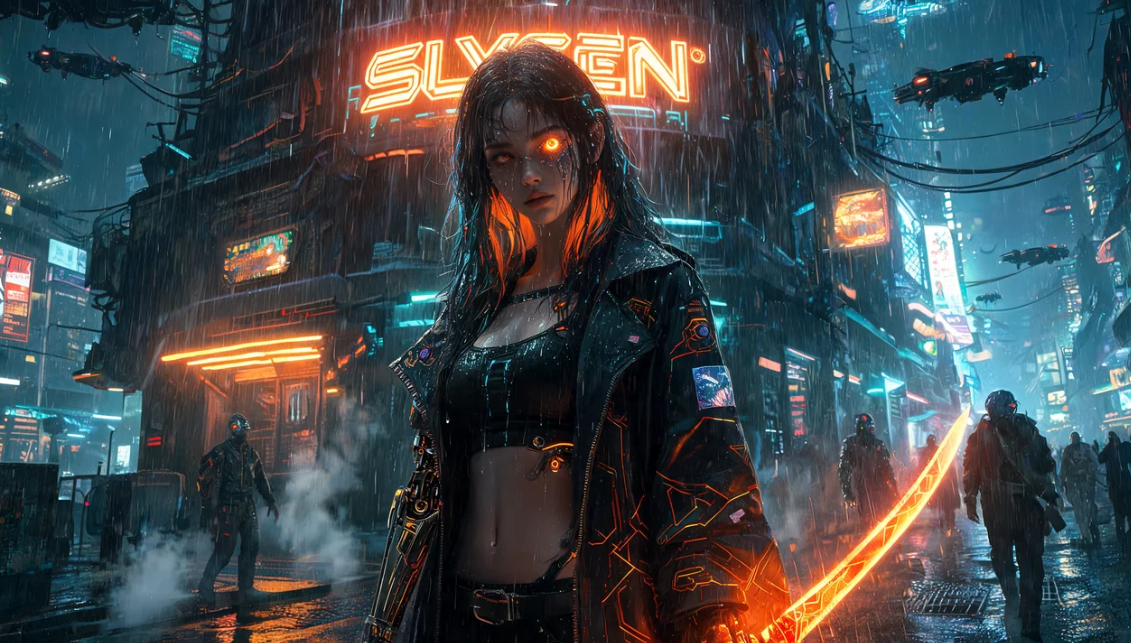
People type "cyberpunk girl" and get a portrait with blue backlighting. There's neon, there's night—but no atmosphere. Because cyberpunk was never built on color. It's a genre about pressure, about the feeling that technology has long spiraled out of control, and that the human inside this entire system is just a cog.
Where this visual language came from
"Blade Runner" (1982). Ridley Scott showed the future as dirty and cramped. Giant corporations—and right next to them, street food markets. Expensive technology just steps away from slums. The future doesn't look new. It looks broken.
Ghost in the Shell picked up the aesthetic, followed by "The Matrix," games, and anime. Over several decades, this became a visual language—one that is read before you even have time to think. High tech, low life. Everything else is just layers on top.
Why most AI images don't look right
Generation latches onto the most obvious layer—neon. But the atmosphere in cyberpunk is assembled from several elements at once. Remove half of them, and you get a fashion portrait with RGB backlighting.
Light here almost never illuminates the scene
There are many sources: signs, screens, headlights, holograms. But the world remains dark—light is local, colored, broken into patches. Blue, purple, red, poison green. White daylight kills the genre almost instantly.
Darkness never disappears. It is simply tinted by neon.
Prompts: neon lighting, colored light reflections, blue and purple light, local light sources, dark background, no daylight, deep shadows
The Japanese visual code didn't appear by chance
Authors of the 80s looked at Tokyo—dense construction, vertical signs, the electric noise of the streets. Hence the entire set: kanji characters, noodle stalls under neon, narrow alleys, wet rooftops. One such detail changes the feeling of the shot—the genre is read immediately.
Prompts: Japanese neon signs with kanji, narrow alleyway, street food stall under neon, wet rooftops, Asian megacity, crowded urban street
Rain is needed not for atmosphere
Rain is a tool for reflections. Wet asphalt doubles the light, puddles add depth, neon spreads across the frame. A dry street almost always looks flat.
Prompts: rain-soaked street, neon reflections in puddles, wet asphalt, glistening pavement, steam from manhole grates
The human must remain human
In cyberpunk, there is always tension between the living and the artificial. Metal next to skin, an implant next to a human eye, wires under the skin. Not an android—a human who is gradually turning into something else. That is where the necessary feeling comes from.
Prompts: cybernetic implants, mechanical arm, wires under skin, eye implant, augmentations as part of body, flesh and metal contrast
The genre has several different directions
And they feel completely different.
Blade Runner — warm yellow lights, smog, dampness, neon dissolved in haze.
Prompts: yellow neon, smog, grimy wet street, light haze, retrofuturism, worn-out city
Ghost in the Shell — more geometry, glass, blue. Technological loneliness.
Prompts: cold blue light, geometric architecture, glass and steel, minimalism, urban isolation
Cyberpunk 2077 — visual overload. Acid shades, chrome on display. Very easy to turn into an RGB mush.
Prompts: acid colors, chrome implants, maximum color saturation, neon overload, body modification
What really helps in prompts
Details that elevate the atmosphere better than the word "cyberpunk":
Prompts: steam from grates, smog and light haze, multiple colored light sources, high-rise megacity background, living city environment, cybernetic implants, background independent from character
The main mistake in almost all generations
The heroine exists in a void. There is a face, there is backlighting—and that's it. The city that presses down is missing. The system in which the human is lost is also missing.
A simple test: remove the character from the frame. A living megacity that continues to exist without the hero should remain. If there's nothing to look at without the character—then there was no cyberpunk there.