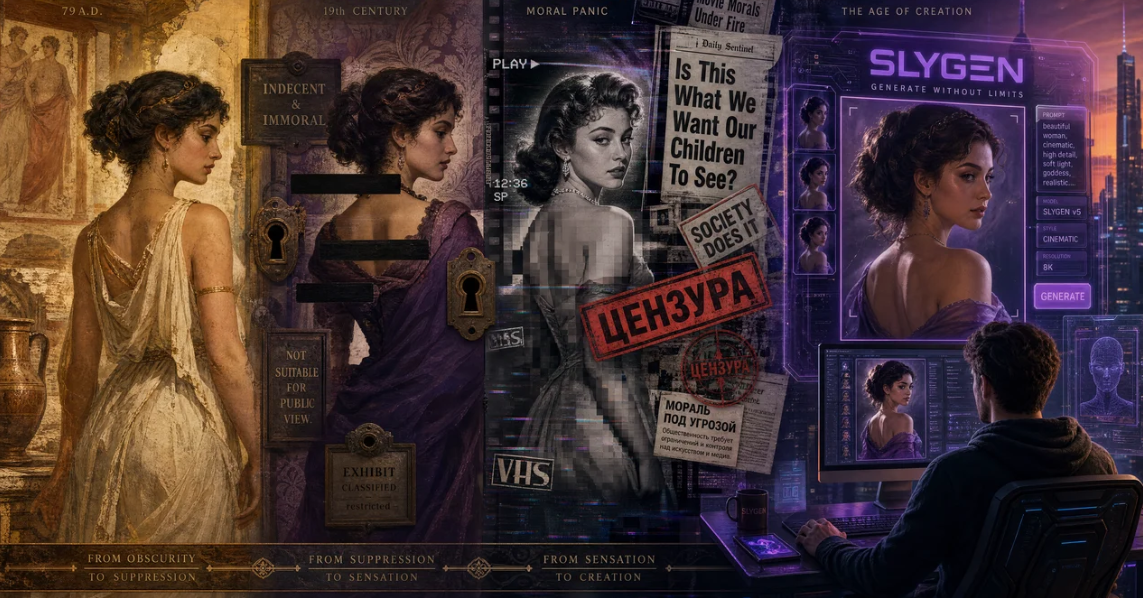
Since antiquity, the erotic image has existed in a strange dual status. It simultaneously attracted and frightened, was part of art and an object of suppression. It was alternately included in everyday culture and pushed into closed spaces. And this fluctuating line lasted for centuries.
Today, technology can not just show or reproduce erotic content, but give a person control over the very process of its creation.
Pompeii: When Erotica Was Not Yet a Problem
In 79 AD, Vesuvius destroyed a city that today is perceived as a cultural paradox. The eruption of Vesuvius preserved a space where erotica was not something hidden. Frescoes in houses, baths, and lupanars depicted scenes that would have been impossible for public display in later eras. Phallic symbols were used as amulets, scenes of intimacy were not separated from art, and the body was not pushed beyond the boundaries of "decent" and "indecent." It simply existed as part of the visual language.
It is not important how explicit these images were by modern standards. What matters is different: they did not require justification.
When the Past Became Indecent
Almost two thousand years later, the same images provoked the opposite reaction. In the 19th century, after archaeological excavations, Europe faced a cultural shock. What was a domestic norm for the Romans became a problem for Victorian morality.
In 1819, King Francis I of Naples ordered access to "indecent" artifacts closed, creating the so-called Gabinetto Segreto. Access there was restricted even among scholars — only for "worthy" visitors. Effectively, the erotic image was institutionally separated from public culture for the first time. And this division was cemented for a long time.
History as a Cycle of Prohibition and Return
If we look more broadly, a repeating pattern becomes visible:
- Middle Ages and Renaissance — nudity acceptable only through myth or religion
- 18th–19th centuries — flourishing of erotica alongside strengthening censorship
- 20th century — mass culture + strict restrictions (film censorship, court cases, moral codes)
- Internet era of the 2000s — explosion of accessibility and parallel strengthening of filters and platform control Each technological wave made erotic content more accessible — and almost immediately triggered a response in the form of restrictions.
But what matters is different: it was not the content itself that was restricted, but the human right to freely engage with their desire.
2026: Breaking the Cycle
Generative neural networks have changed the very structure of this system. Now the visual scene is not chosen from a set of ready-made options. It is created from text, from the formulation of intention. A static image or description turns into a dynamic video: with movement, light, atmosphere, rhythm. And this changes not the format, but the architecture of interaction.
Key Shifts:
- No other body as an obligatory object. Instead of searching for ready-made content — creating your own scene.
- No centralized production. Generation happens locally, in the user's private space.
- No external editor of meaning. The user themselves defines the boundaries of the permissible.
- Full role freedom. One person combines the roles of director, screenwriter, and viewer.
Psychological Effect: The Disappearance of the Intermediary
At the psychological level, a less obvious but more important shift occurs. When external control disappears, internal control gradually weakens as well. Users of such systems often describe not "increased stimulation," but something else:
- reduced tension around their own fantasies
- decreased sense of forbiddenness
- clearer understanding of their own preferences
- reduced internal conflict between desire and norm In other words, erotica returns from the realm of social control to the realm of personal experience.
Erotica as a Form of Personal Practice
If previously erotic content existed as an industry, now it is increasingly shifting towards individual work with imagination. Not as consumption. But as tuning a state. In this sense, AI generation is closer not to media, but to a tool: something between visual design, psychological practice, and creative process.
The Historical Loop Closes An interesting paradox: the digital age not only destroys old restrictions, it partially returns us to an earlier model. To a culture where the erotic image is not separated from everyday life by rigid boundaries of shame and prohibition. The difference is only that now this happens not in public space, but within individual digital experience.
The erotic image has always been an indicator of how society works with desire: suppresses it, regulates it, or integrates it. Neural networks did not "liberate" erotic content in a simplified sense. They did something else — they removed the intermediary between imagination and its visual form. And in this sense, the main shift of 2026 is not technological, but cultural: desire for the first time became not something that needs to be hidden or adapted, but something that can be directly shaped as a personal visual language.